
Exploring the 5 Building Blocks of Language
Communication Subdomain 1: Early Social Language Skills
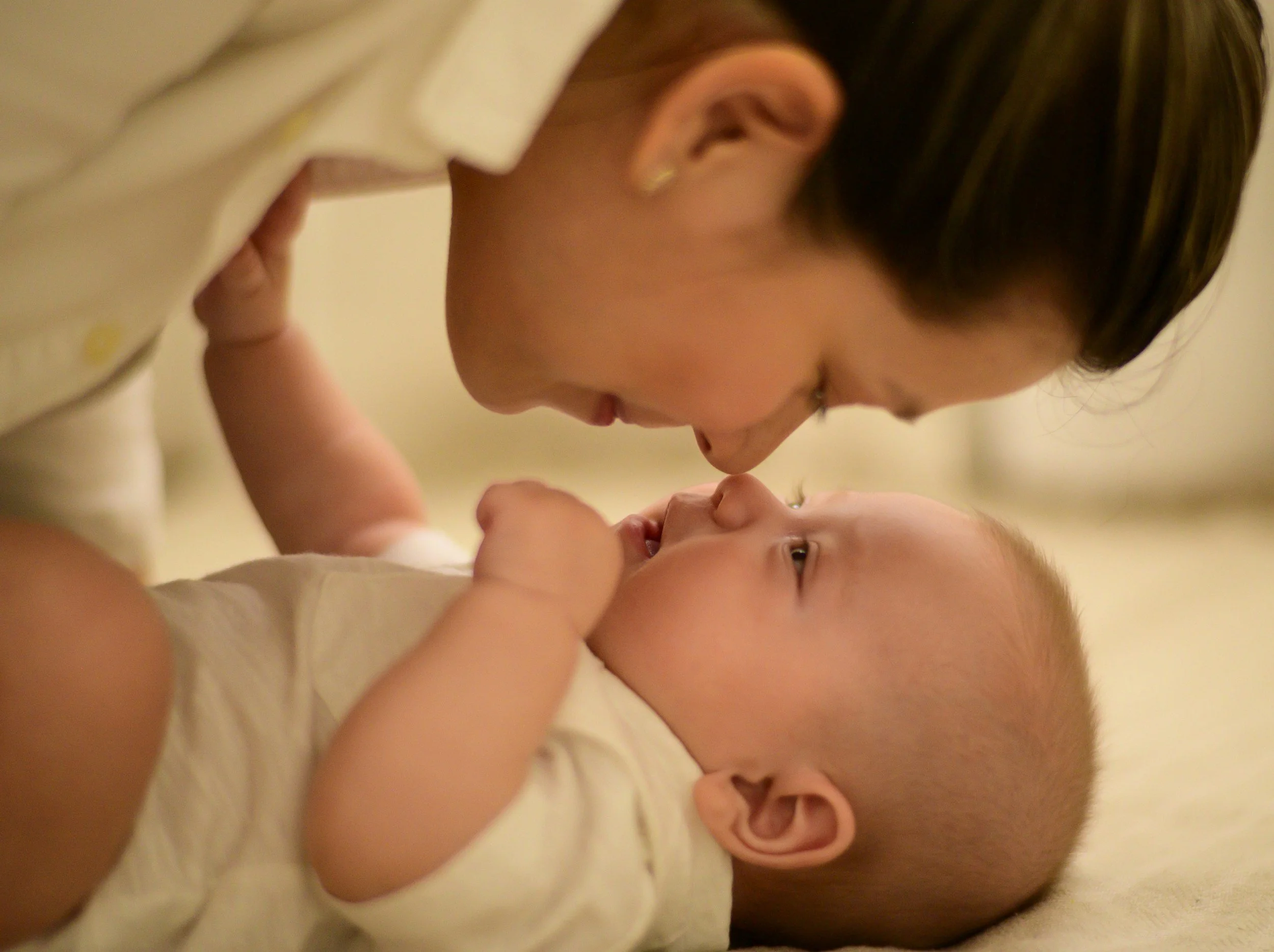
It begins at birth and describes the earliest forms of communication children use before they start talking. In the beginning, babies make sounds, move their bodies, look at people, and use simple gestures—but they are not yet communicating on purpose.
Children are considered to have intentional communication when they begin to show a set of behaviors such as:
using gestures, sounds, or eye contact to get someone’s attention or to influence what the other person does,
looking back and forth between a person and an object or event (joint attention),
pausing and waiting for a response after they try to communicate, and
trying again if their message is not understood.
These early intentional communication skills are very important because the more often children use them, the stronger their later language skills tend to be.
One especially important early skill is joint visual attention (JVA). A child is responding to JVA when they follow where an adult is looking—turning their eyes to the same object or event. A child initiates JVA when they point to, show, or hold up something because they want someone else to look at it too. This is one of the first true back-and-forth communication actions children use. Most children begin to show reliable joint attention between 10 and 12 months.
Between 8 and 15 months, children begin to use early social communication skills called pragmatic functions. These include requesting objects or actions, refusing, and commenting on things around them. Between 16 and 23 months, they add even more functions, such as asking for information, answering simple questions, and showing that they heard or understood a response.
It’s important to remember that children can communicate these functions in many ways—not just with words. A child can request by pointing, reaching, using a gesture with a sound, saying a single word, or using a short phrase (for example, “Want cookie”). All of these forms count as communication; they just differ in how much language the child uses.
In the earliest stages of Communication Subdomain 1, most of a child’s “conversational turns” will be nonverbal. Instead of talking, they take turns by pointing, reaching, making eye contact, or using other simple actions to send a message.
The early pragmatic skills in Communication Subdomain 1—such as joint visual attention and turn-taking—are the foundation for all later communication. Children who are developing typically show these social communication abilities before they start using words.
This means that even with older children who have delayed or atypical communication, building these early social skills may still be necessary. For example, if I am working with an older student with an intellectual disability who is not yet showing joint attention, turn-taking, or imitation, therapy will begin with these basic skills.
Focusing on these underlying social abilities is often the first step during assessment. If an SLP or special educator notices that a child has difficulty starting interactions, joining interactions, or staying engaged, then Communication Subdomain 1 becomes the primary focus of intervention.
Communication Subdomain 2: Single Words/Early Vocabulary Development
Vocabulary development starts near the end of a child’s first year and continues to grow throughout life. Vocabulary grows rapidly during the preschool years and then increases again during the school years.
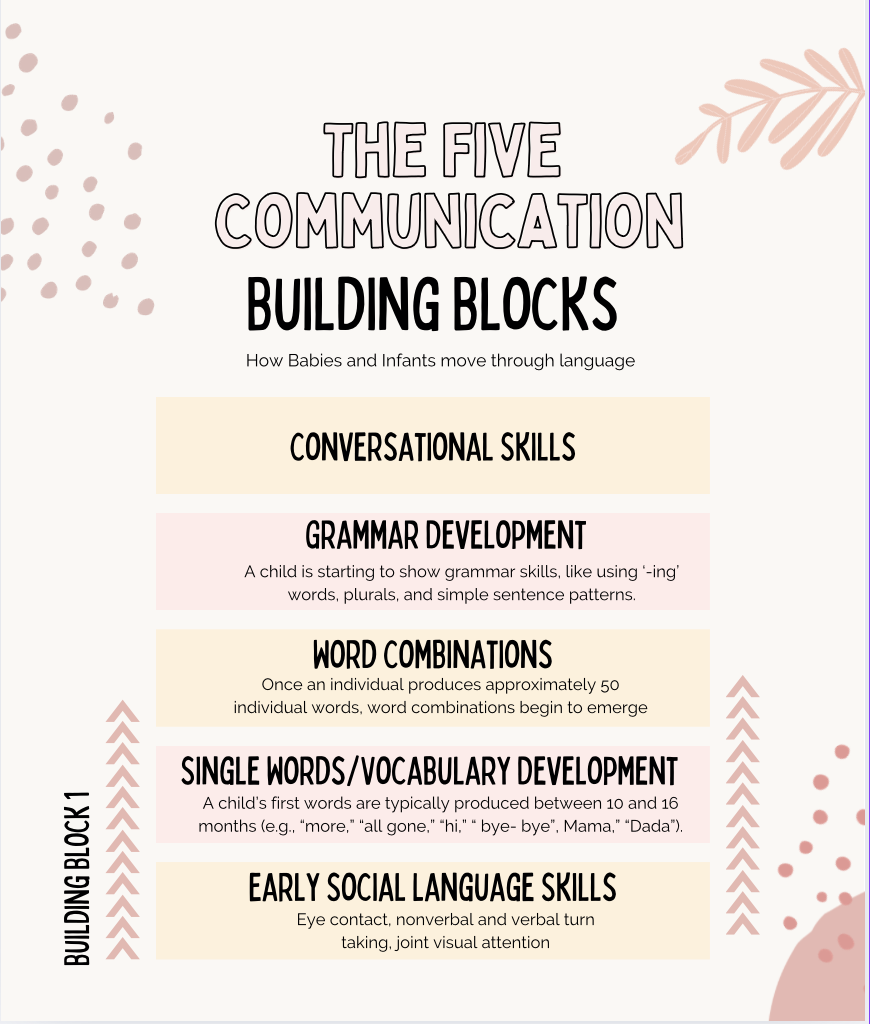
Most children say their first words between 10 and 16 months. These early words usually fall into a few common categories:
Appearance / disappearance / recurrence (examples: “more,” “all gone,” “hi,” “bye-bye”)
Names of people, pets, or favorite objects (“Mama,” “Dada,” “kitty,” “light”)
Feelings or attitudes (“hug,” “no”)
Fillmore (1968) suggested that children understand the meanings of words before they learn grammar. He called this idea case grammar.
Vocabulary grows quickly. By age 2, most children use 200–500 words and understand far more than they can say (Fernald et al., 2001). By 30 months, their vocabulary typically includes:
about 54% common nouns (people, places, things),
7% verbs,
5% adjectives,
and smaller numbers of function words (like “the,” “a,” “and,” “mine”) and sound effects (Caselli, Casadio, & Bates, 2001).
Many communication disorders—including developmental delays, autism spectrum disorder, hearing loss, and specific language impairment—can cause semantic (vocabulary) difficulties.
SLPs regularly check whether a child’s vocabulary level supports communication and academic learning. In the early stages of vocabulary, they look at whether the child is using different types of word meanings (semantic categories). Many children with language delays use too few action words (verbs), which makes it hard for them to build sentences. Because of this, SLPs often teach caregivers how to encourage a wider variety of word types at home.
Communication Subdomain 3: 2-3 Word Combinations
Once a child uses about 50 single words, they usually begin to put two words together. Before this happens, the child needs the foundation built in the earlier communication subdomains:
Subdomain 1: Early social communication skills such as joint attention, turn-taking, imitation, and early pragmatic skills
Subdomain 2: Single words
Subdomain 3: Early word combinations
These early skills need to develop before a child is ready for Subdomain 4, which includes grammar (morphology and syntax). In the first three subdomains, children are not yet using grammar rules. If any of these earlier skills are delayed or missing, those areas are the focus of intervention.
Communication Subdomain 3 is different from Subdomain 4 because children are not yet using adult-like sentences or grammar. Instead of following syntax rules, children simply combine words to express basic meanings. They may:
Name people or objects
Describe what someone or something is doing
Describe characteristics
Indicate who something belongs to
SLPs describe these early word combinations using semantic roles such as:
agent (the one doing the action), action, object, location, possession, and attributes.
It is important to judge early word combinations in context, because the same two words can mean different things depending on the situation. For example, “Doggie house” might mean:
“The dog is in the house,”
“That is the dog’s house,” or
“I want the dog to come into the house.”
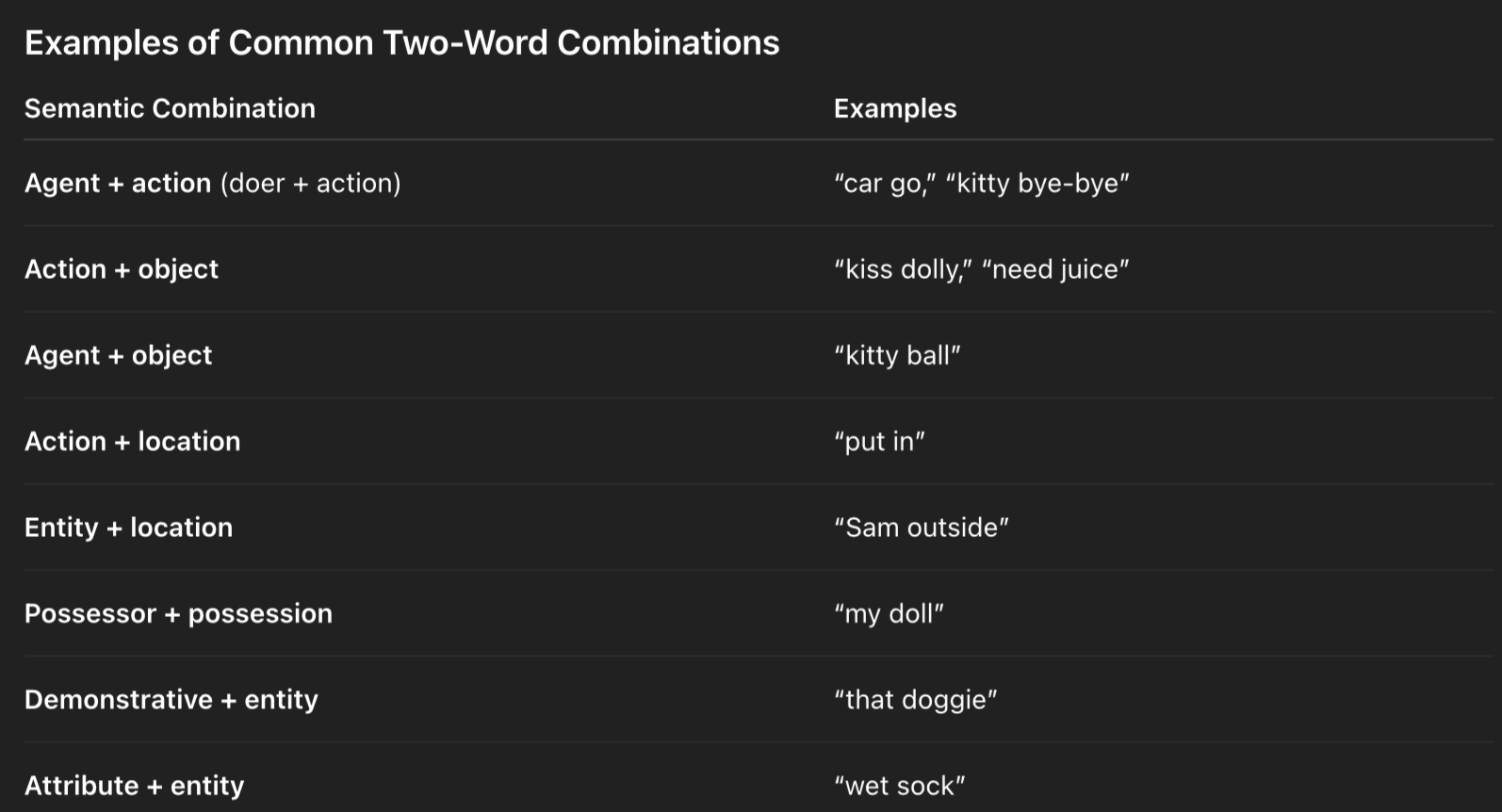
Once a child shows the foundational early pragmatic skills from Communication Subdomain 1 (such as joint attention, turn-taking, and imitation) and has a vocabulary of more than 50 single words (from early Communication Subdomain 2), we begin targeting early word combinations, which are part of Communication Subdomain 3.
To support the development of these early combinations, practitioners use play-based activities—such as building with blocks, playing with trucks, or engaging in pretend play with dolls—to naturally encourage children to use two-word or multiple-word combinations. Caregivers are also taught how to help their child use and expand these early semantic combinations during everyday routines.
Communication Subdomain 4: Grammar Development
As children grow, their sentences start to show grammar skills—how we put words together and add endings to make meaning clearer. These early grammar steps usually appear between 2 and 3 years old. For example, children start using:
–ing (running, eating)
plural –s (dogs, toys)
By about age 5, most children use longer, more complex sentences that include extra details and ideas.
Before we work on grammar, SLPs make sure that a child:
Can use basic social communication skills—like taking turns, showing joint attention, and using simple communication functions (Subdomain 1).
Can combine words in different meaningful ways—like “more juice,” “Mommy go,” or “my truck” (Subdomain 3).
Once these skills are solid, the SLP looks at the child’s grammar using Brown’s stages.
Grammar continues to grow throughout the school years. Many older children with language needs have trouble with grammar when they read harder books or when they write for school.
For school-age students, SLPs often focus on helping children use:
sentences with connecting words, like and, but, because, after, or then
sentences that include extra information or clauses (e.g., “The boy who is wearing the red shirt is my friend.”)
Communication Subdomain 5: Conversational Skills
Between ages 3 and 7, children’s social and conversational (pragmatic/discourse) skills grow a lot. During these years, children begin to use language to:
Explain their thinking and talk through problems
Share past experiences (“Remember when we went to the park?”)
Predict what might happen next
Show empathy and understand how others feel
Get along with peers and understand social roles
Use and understand politeness and early sarcasm
Adjust how they talk depending on the situation and who they’re talking to (code-switching)
As children move into the school years, they continue to grow in these social communication skills. Their conversations become more organized, more flexible, and more sophisticated as they learn to communicate in a wider range of social and academic situations.